About Paradigma
We are automating science.
What we do
We train the models, build the infrastructure and run the agents that do scientific research.
- Models
- We are a lab with frontier ambitions. We train our own models for scientific research, across the entire stack from pretraining to post-training. Our first, Limite 1B - Violetto, rivals models tens of times its size on competition-level math, trained with ten to a thousand times less compute.
- Infra
- A new age of research needs new ways of doing it. Flywheel records research as a graph of hypotheses, experiments and results, each step committed like code, so people and agents can check the work and build on it instead of reconstructing it from a PDF.
- Discovery Wells
- We orchestrate our models and agents in what we call Discovery Wells, each working autonomously and continuously on one problem to get the most discoveries per unit of energy. A Discovery Well proposes ideas, runs the experiments and checks the results. We run them on companies’ R&D problems and on our own, turning science into an industrial process.
Why
We are scientists, and we can feel science giving way under the weight of AI.
- Why science
- Our hardest problems, in health, energy and climate, are waiting on knowledge we do not have yet. Science pays down that debt, and the technology it makes possible is what lets people flourish.
- What is breaking
- Conferences now receive more papers than anyone can review. A PDF shows only what its authors chose to show, and much of what gets published cannot be reproduced. We wrote a proposal for something better.
- What we think
- It doesn’t have to be this way. Discovery is limited by how many people can work on a problem, and AI can make it limited by compute instead. We think that is the highest-leverage thing we can work on, and we set out why in The New Age of Research.
Founders
We built frontier benchmarks at OpenAI, pretrain language models, and run Italy’s largest academic AI lab.
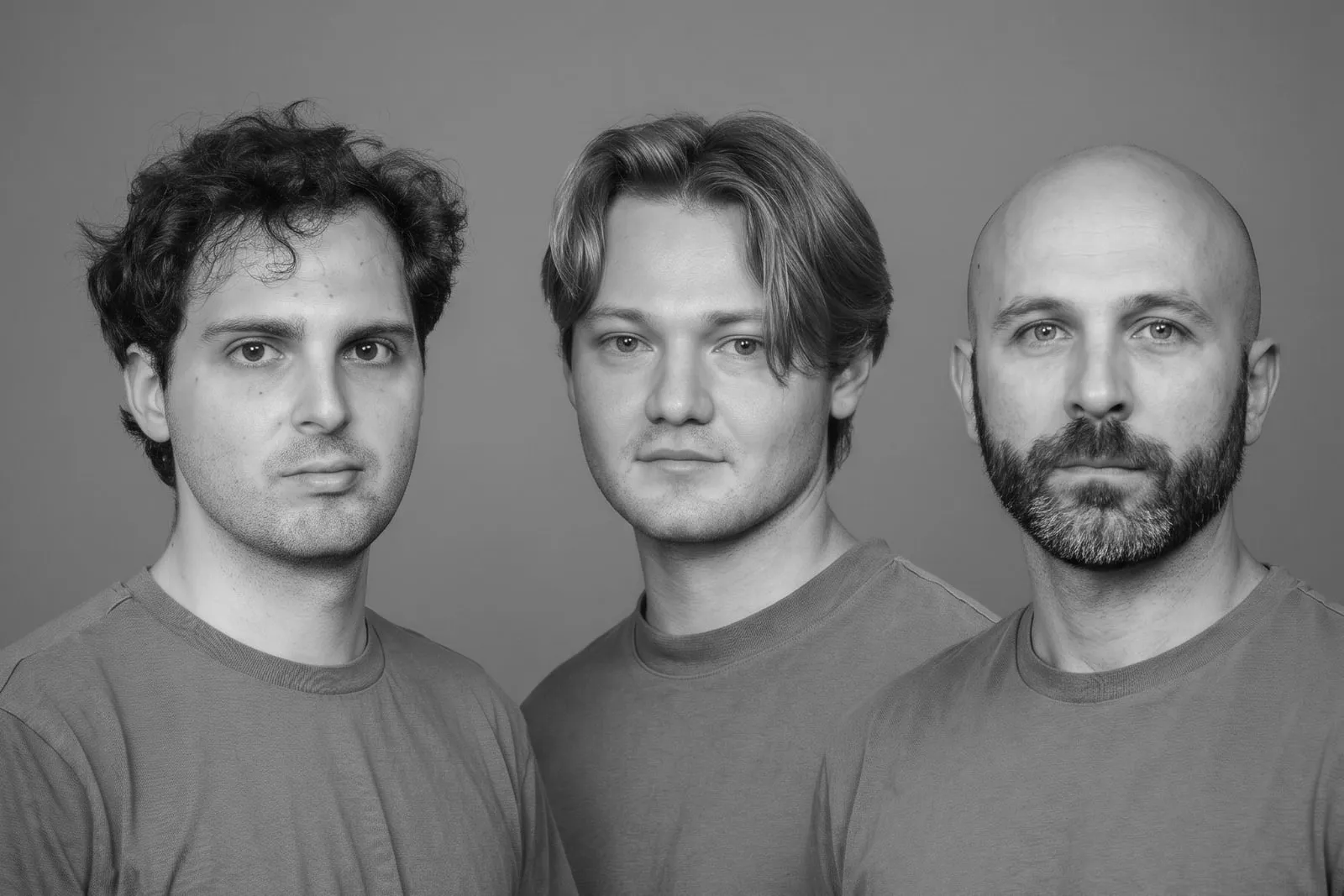
Giulio Starace
Cofounder and President
Giulio spent two years on OpenAI’s Preparedness team, where he built SWE-bench Verified, MLE-bench and PaperBench, which he led as first author. They measure how well AI agents do software engineering and machine learning research, and frontier labs report them when they release new models. He studied physics at Durham University and AI at the University of Amsterdam.
Francesco Pappone
Cofounder and CEO
Francesco works on how language models are pretrained and how they are built. It was the subject of his PhD at Sapienza, which he left to start Paradigma, and of his writing at The Tensor Throne and in The New Age of Research. He trained in physics and applied mathematics, holds an MBA, and as an undergraduate cofounded a nonprofit against brain drain from Italy.
Emanuele Rodolà
Cofounder and Chief Scientist
Emanuele is a full professor of AI at Sapienza University of Rome, the youngest in Italy’s history to hold the title, and leads GLADIA, the largest academic AI lab in the country. He is one of the pioneers of geometric deep learning and functional maps, and GLADIA now leads work on model merging. His research has over 16,000 citations and an h‑index of 54, and his former students now work at Anthropic, Apple and Amazon.
Rome
The new paradigm will come from a new place.
- Focus
- Our work is research. It needs a mission, the right people and long stretches of uninterrupted work, and Rome gives us all three. The conversations that matter happen online anyway, and the place everyone else congregates tends to become an echo chamber. Moving there would mean accepting the world as it is. We would rather shape it.
- Talent leverage
- This field rewards plasticity over experience, and many of the best researchers are barely out of university. Italy and Europe are brimming with them, and few companies here are trying to hire them. The team that trained Limite 1B - Violetto came from Sapienza’s undergraduate programme, and the oldest of them was 22. Building here selects for people who come for the mission.
- Europe
- In the 1930s, Enrico Fermi’s young physicists on Via Panisperna put Rome at the frontier of science. Italy has since watched its best researchers leave, and many of them would come back for the right work. We want to bring the frontier back. Europe will need frontier AI know-how of its own, for its economy and its security, and we are building it here.